Dashboard warning lights: what to do, and what can wait
The colour tells you the urgency. The symbol tells you the system. Neither tells you the cause — that takes testing.
Dashboard lights follow a traffic light convention, and it is more useful than most drivers realise. Red means stop as soon as it is safe. Amber means something needs attention, but you are not in immediate danger. Green and blue are information only — the system is simply on.
Red: stop when it is safe to do so
- Oil pressure — an oil can symbol means the engine may not be receiving oil. Stop immediately; driving on can destroy an engine in minutes.
- Engine temperature — pull over and let it cool. Do not open the radiator cap on a hot engine.
- Charging system — the vehicle is running on stored battery charge and will eventually stop. Head straight to a workshop.
- Brake warning — check the handbrake is fully released. If it stays on, treat the brakes as unreliable.
Amber: book it in, but do not panic
The check engine light is the one everyone recognises. Steady amber usually means the engine management system has recorded a fault worth investigating soon. A flashing engine light is different — it typically indicates a misfire severe enough to damage the catalytic converter, so reduce speed and load and get it looked at promptly.
ABS, traction control and tyre pressure warnings also sit in amber. The vehicle still drives, but a safety system is degraded, and that only shows up when you need it.
Why a code is not a diagnosis
A fault code identifies the circuit or system that reported a reading outside its expected range. It does not identify the failed part. A code naming an oxygen sensor is just as often caused by an air leak, an injector or wiring as by the sensor itself — which is why replacing the part the code names is the most common way to spend money without fixing anything.
What proper diagnosis looks like
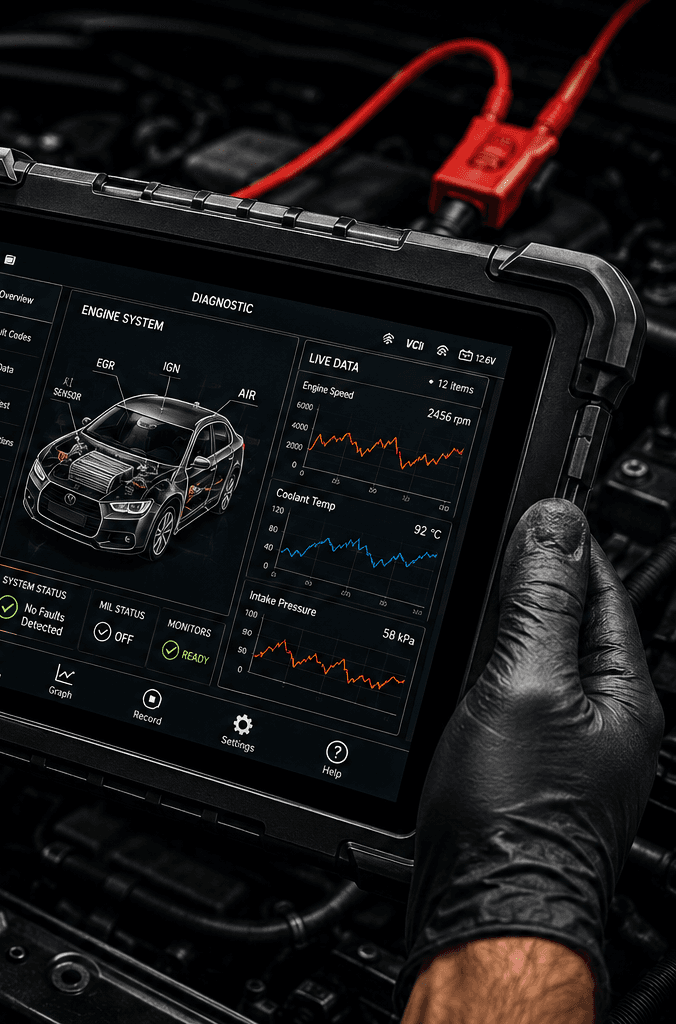
Scan every module, not just the engine. Record stored, pending and permanent codes. Read the freeze-frame data to see what the vehicle was doing when the fault triggered. Then test the circuit — live data under load, at operating temperature, and on the road if the fault is speed or load related.
That testing is what you are paying a workshop for. Plugging in a scan tool takes a minute; proving which component is responsible is the part that saves you from replacing three parts to fix one problem.